Friday, December 11, 2009

Environmental Blues: No Justice, No Peace

Environmental Blues: No Justice, No Peace

Thursday, December 10, 2009 was an eventful day and one to be remembered by the world community.

It was designated Human Rights Day.

It was the day President Barack Obama accepted his Nobel Peace Prize in Oslo, Norway.

It was a day when participants at the biggest climate meeting in history, the United Nations Climate Change Conference, with 15,000 participants from 192 nations in Copenhagen seeking to agree on curbs on greenhouse gas emissions and raise billions of dollars for the poor in aid and clean technology, witnessed indigenous people from all regions of the globe - marching, protesting and demanding that the industrial nation states cease and desist oppressing indigenous people globally through their devastating energy policies and practices and endorse the Declaration on the Rights of Indigenous People

Are these events connected? How so? How do any of these actions affect us? Do we bear any responsibility for Human Rights, for Peace, for War, for Climate Change, for Climate Debt?

Was President Obama’s Nobel peace acceptance speech more rhetoric than reality? In halting phrases President Obama hung together a contradictory justification for war that artfully attempted to ground its volatile essence to a moral compass. He was reaching for the world that ought to be, trying to find the spark of the divine that stirs our soul. He strove mightily to find justice in the face of escalating U.S. aggression and perceived oppression. He alluded to a “just war” that can lead to a “just peace” as he argued that the use of force will not eradicate violence but nonetheless can be “morally” justified. He praised Gandhi and King for their courage as nonviolent agents of change and acknowledged “ I am living testimony to the moral force of non-violence.” However, he appeared to reject that moral force saying that he cannot be guided by their example alone. He believes “that force can be justified on humanitarian grounds.” We all must concede, he claims, “that the instruments of war have a role to play in preserving peace”. It is difficult Obama conceded to reconcile these two seemingly irreconcilable truths. He continued, that “where force is necessary” we are morally bound by “rules of conduct” that, among other things, forbid torture – the prison at Guantanamo Bay- and genocide, repression and brutalization of people - Darfur, Congo, Burma – or there will be consequences, he admonished. “A just peace includes not only civil and political rights—it must encompass economic security and opportunity. For true peace is not just freedom from fear, but freedom from want.”

How did the indigenous people receive President Obama’s message: “Immense Hypocrisy” said Clayton Thomas- Mueller of the Canadian based Indigenous Tar Sands Campaign, long time environmental activist with the Indigenous Environmental Network. Mueller marched with hundreds of tribal people, a coalition of North American indigenous groups, on the U.S. embassy in Copenhagen demanding that the U.S. energy industry stop waging war on native people and land. Faith Gemmill of Artic Village in Alaska –she works with the group Resisting environmental Destruction on Indigenous lands--passionately pleaded for immediate cessation of industrial nations’ energy policies and unsustainable development practices that threaten the very existence of indigenous people. All across the Americas she asserted, indigenous communities are under threat by fossil fuel extraction.

Kumi Naidoo, long time South African anti-apartheid activist and the new executive director of Greenpeace International expressed his disappointment with President Obama’s acceptance speech. He congratulated Obama’s achievement but found the president spent too much time on justifying war, too little time looking at the root causes of war, and in fact, made only one passing reference to climate change during the biggest summit ever on this urgent problem. How could this be he mused when climate change is driving up conflict across the world and, in fact, is probable the biggest threat to our security in the future.

But how surprising is the dysfunctional response by the U.S. in the face of a global summit to address energy policies “that sacrifice communities at the altar of irresponsible policies for the economic benefit of the select few who pull the political strings.” Clayton Thomas-Mueller.

One hundred and ninety two nations have convened a democratic process and are working feverishly to deliver a fair, ambitious and legally binding treaty to avert climate catastrophe. The politicians have 2 weeks to save the planet from catastrophic climate change in the talks, which end with a summit of 105 world leaders -- including U.S. President Barack Obama, on Dec. 18.

But a hidden agenda has emerged when the U.S. delegation meekly hid behind the skirts of the Danish government. Todd Stern, leader of the US delegation, surprised many playing a negative role when he revealed that the US government was not pushing for a legally binding treaty because it was the preference of the Danish government not to do so. How strange it seems that the Danish government has become a primary disruptive force in an apparent U.S. plot to dislodge an established and orderly democratic process in Copenhagen.

Apparently Darth Vader has surfaced in Copenhagen determined to reek havoc upon developing countries that have virtually no responsibility in the looming climate catastrophe and are paying the biggest price. One of the deal breakers behind the negotiations scene is the demand that developed nations acknowledge their collective climate debt to their former colonized developing countries. That is, reparations by those who has spent the last 200 plus years – since the Industrial Revolution—blissfully ignorant that emissions caused a green house effect. Well, Darth -aka Todd Stern, says that because global warming is a relatively recent phenomenon, climate debt is the wrong way to look at this. “We absolutely recognize our historic role in putting emissions in the atmosphere. …that are there now. But the sense of guilt or culpability or reparations, I just –I categorically reject that. “

So we ask Todd Stevens, the chief U.S. climate negotiator, do you reject the fact the U.S population which is less than 5% of the world’s population, historically and presently contribute in excess of 20% of harmful emissions into the atmosphere? Do you categorically reject any responsibility to give substantial financial support and transfer technology and intellectual property assets to developing countries so their populations may appropriately adapt and attain food and water security?

And what about President Obama. Will he continue the policies of denial practiced for eight years by President Bush? Or will he listen the voice of 54% of the American people who according recent public opinion surveys want action on climate change?

What is our responsibility to save ourselves, the generations to come and our planet? Will we go along to get along? Will we be a “Nation of Sheep” ---BAAH BAAH BAAH -- in our closed pen waiting to be fleeced again and again to support the market driven economy and perpetual war that depends on our consumption and serfdom to keep hegemony on track for a new world order?

Some 56 newspapers from 45 countries including The Guardian, Le Monde, El Pais and Toronto Star on Monday published a joint editorial urging world leaders to take decisive action.

"Humanity faces a profound emergency. Unless we combine to take decisive action, climate change will ravage our planet," it said.

"The politicians in Copenhagen have the power to shape history's judgment on this generation: one that saw a challenge and rose to it, or one so stupid that we saw a calamity coming but did not avert it."

We are all related and we must use the force of grassroots movements to prod reluctant politicians to embrace a new paradigm where human rights, climate change, environmental justice, war and peace, security, financial prosperity and equality are understood to be parts of whole cloth that must be woven together for survival of all species.

A Path Forward

From 20-24 April 2009, Indigenous representatives from the Arctic, North America, Asia, Pacific, Latin America, Africa, Caribbean and Russia met in Anchorage, Alaska for the Indigenous Peoples’ Global Summit on Climate Change. They wrote a comprehensive document, “The Anchorage Declaration” which serves as a guide for our collective path forward.

“We are deeply alarmed by the accelerating climate devastation brought about by unsustainable development. We are experiencing profound and disproportionate adverse impacts on our cultures, human and environmental health, human rights, well-being, traditional livelihoods, food systems and food sovereignty, local infrastructure, economic viability, and our very survival as Indigenous Peoples.

Mother Earth is no longer in a period of climate change, but in climate crisis. We therefore insist on an immediate end to the destruction and desecration of the elements of life. “

The Anchorage Declaration “Calls for Action” stated in part:

1. In order to achieve the fundamental objective of the United Nations Framework Convention on Climate Change (UNFCCC), we call upon the fifteenth meeting of the Conference of the Parties to the UNFCCC to support a binding emissions reduction target for developed countries (Annex 1) of at least 45% below 1990 levels by 2020 and at least 95% by 2050. In recognizing the root causes of climate change, participants call upon States to work towards decreasing dependency on fossil fuels. We further call for a just transition to decentralized renewable energy economies, sources and systems owned and controlled by our local communities to achieve energy security and sovereignty.

http://www.indigenoussummit.com/servlet/content/home.html

Monday, August 10, 2009

UNREPENTANT

Telling the Untold Story of the Genocide of Aboriginal Peoples in Canada


Preamble: Who are We and What Can We Become?

The time has come to end our complicity in mass murder.

Our exposure of the Canadian genocide has simultaneously indicted the social order that gave rise to it. Euro-Canadian Christian society as a whole stands condemned in the dock alongside those persons who ran the Indian residential schools, sterilized and murdered children, spread smallpox, and dug mass graves.

Despite their best efforts to ignore this fact and contain the whole matter with pseudo “apologies”, the Canadian government and its partner Catholic, Anglican and United churches now face the same kind of historical reckoning that Nazi Germany did after its defeat in 1945: an awakening to their own criminal nature.

On April 20, 2007, Canada and those churches suffered a fundamental moral defeat in Parliament, when the first cabinet minister in Canadian history publicly acknowledged that untold thousands of children had died in Christian Indian residential schools.

The extent of this defeat has yet to be appreciated by most Canadians, or even indigenous people. But its impact is nevertheless reverberating throughout every level of society and undermining the very basis of Canada ’s existence.

The question now is how to draw the larger conclusions of this defeat in order to reinvent Canada from the top down, and the bottom up, with a basic purpose: the establishment of a decolonized, secular, and genuinely democratic federation of sovereign nations: The Republic of Kanata.

Shedding the Past, Creating a Future

Canada has never been allowed to become a sovereign and democratic nation because of its historical role as a resource base and captured market for first the British and then the American empire. That dependency required that Canada remain frozen as a colonial, church-dominated, semi-feudal society: a condition that has caused the sustained genocide of indigenous peoples and the destruction of their lands, and now threatens the lives of all of us.

The two attempted democratic revolutions in our history – the abortive rebellions in 1837 in Upper and Lower Canada, and the Metis Insurrection of 1885 in the Red River basin – had as their common aim the ending of an Imperial oligarchy and the creation of a democratic Republic in which aboriginals and Europeans could co-exist equally. The crushing of both rebellions ensured that oligarchy and apartheid would remain the political norm in Canada.

And yet, the same vision of freedom that propelled these revolts had been first offered by the eastern Six Nations to the arriving Europeans through the “Two Road Wampum” Great Law of Peace, in which both cultures would share the land and not seek to dominate or conquer the other.

That offer was rejected not by Europeans as a whole, but by the religious and commercial elites who ran the foreign policy of both the French and British Empires, especially during the European Religious Wars of the formative 17th century.

Time and again, the Catholic and Protestant churches subverted peaceful relations between whites and natives, and among aboriginal nations such as the Huron and Iroquois, as part of their plan to exterminate all non-Christian peoples and take their land. In the words of the Jesuit missionary Jean Brebeuf,

“There can be no peace or parity between the savages and Christians. This is required by our Faith and the fur trade.”

Canada as we know it has arisen on the basis of this basic philosophy of Christian Superior Dominion.

There is still no equality between natives and non-natives in Canada because of an apartheid Indian Act that relegates “Indians” to a separate and inferior status, and holds most of them in a state of permanent sickness, landlessness and poverty on their own lands. Such permanentinternal colonialism is required by the foreign and domestic corporate interests that run Canada as a fuel pump and watering hole.

Quite simply, in a neo-colonial regime like Canada , where “the Crown” legally owns all the land, native people must continue to be killed off, legally and methodically, for such theft to continue. A constant aboriginal death rate twenty times the national average is the deadly proof of this regime.

This genocidal reality will never change in Canada as it is presently constituted, since the maintenance of natives, and the poor generally, as a disempowered cash cow for others to exploit is an institutionalized part of Canadian society.

The nine billion dollar Indian Affairs industry requires a sick, dependent aboriginal populace, and a compliant class of collaborating native elites to administer this sickness. For the resulting totalitarian control of native people at every level is precisely what resource-hungry corporations need to take the last remnants of oil, timber, minerals and water from what is still aboriginal land.

Such a structurally criminal regime cannot be tinkered with or reformed, resting as it does on the oppression of most of the population, whether native or non-native. The existence of Canadians as “subjects of the Crown” under the ultimate authority of one person – a Governor-General accountable only to a foreign monarch – amounts to a state of legal slavery utterly repugnant to democracy and sovereignty.

The only way to reform a colonial system is by dismantling it” said the great Irish nationalist, Bernadette Devlin. And the key to dismantling the Canadian oligarchy is to establish responsible government by severing ties with the English monarchy and creating a federated and secular Republic of sovereign indigenous nations with full public ownership of the economy, the land, and all its resources.

In short, every vestige of the system that spawned genocide in Canada needs to be abolished, if we are serious about ending its legacy and doing justice to aboriginal people and residential school survivors.

We believe that the original vision of the Two Road Wampum is still possible to enact in our land: of equality and living justice between all our nations. But to build this dream, we must first dismantle that which has prevented it.

A Program for Ending Genocide

Legal genocide in Canada has rested historically on three pillars: a colonial political oligarchy under the authority of the English Crown; a powerful, unaccountable and state-protected religious oligarchy in the Roman Catholic and Anglican churches, and later, the state-created United Church; and a foreign-controlled, dependent economy.

To dismantle the root causes of genocide in Canada, we must replace all three of these systems, through a process of active de-construction and reconstruction: undoing what caused the wrong and building an altogether new political and social regime in its place.

To commence, our general aim must be the following steps of “decolonization and de-construction” in order to lay the basis for a true democratic and secular Republic:

I. Politically: Active disaffiliation from the English Crown and the Canadian state and its courts;

II. Spiritually: Disestablishment of the Roman Catholic, Anglican and United Church of Canada; and

III. Socially: De-corporatizing our economy and establishing local, self-sufficient economies under public ownership.

A real Program of Justice for all victims of genocide in Canada must restore social equality, the health of the land, and democratic sovereignty of all nations within Kanata , through these and other measures:

I. Politically:

1. Abolish the office of the Governor-General, disavow all Oaths of Allegiance to the British Crown, and issue a formal Declaration of Independence from the Crown.

2. Establish a new Constitution of the Republic of Kanata. Reconstitute Canada as a federated and secular Republic of Kanata, based on a recognition of the root title sovereignty of all indigenous nations and of the common ownership by all citizens of the economy, wealth, lands and resources of Kanata.

3. Abolish the Canadian armed forces, the Indian Act, the federal and provincial courts, the Senate, the RCMP, and the Indian and Northern Affairs department and their puppet aboriginal agencies.

4. Create a new standing army based on popular citizen militias.

5. Establish popular, indigenous courts of law.

II.Spiritually:

1. Tax the churches: Revoke the charitable tax-exempt status of the Roman Catholic, Anglican and United Church, nationalize all church property and land, audit and assess all payments owed by these churches to the people and indigenous nations since their inception, and return all lands and effects stolen by these churches from native people.

2. Revoke the legal charters and legislation governing the Roman Catholic, Anglican and United Church of Canada, and thereby end their official, legal status.

3. End diplomatic recognition of the Vatican and expel the Papal Nuncio.

4. Separate church and state: no funding for religious schools or churches, no religious oaths or functions connected to the state, no state protection for clergy or churches (ie, revoke sections 176 and 296 of the Criminal Code of Canada).

5. Establish a public, international inquiry into crimes of these churches against native people, including in Indian residential schools, with the power to subpoena, try and jail offenders.

III. Socially

A Jubilee Campaign to restore the land and economy to the people:

1. Cancel all debts and mortgages, and return all land to its original owners.

2. Place banks, money supply and credit under public ownership and control.

3. Impose a 100% tax on all wealth gained by inheritance, interest and speculation, and abolish all income tax.

4. Establish a maximum wage and redistribute all surplus income to the lower paid.

5. Collect all back taxes owed by corporations and impose a special tax on the super wealthy and on corporate profits.

6. Abolish foreign ownership of the economy.

7. Abolish all land speculation and the commercial trading in land.

8. Nationalize all resources.

9. Socialize all housing, medicine, education and transportation, and make these services freely available to all people.

10. Create Local Exchange and Trading (LET) networks across Kanata to decentralize and democratize the economy, abolish money and credit, and harmonize humanity with the earth.

A Gaia Campaign to restore the health and harmony of the land:

1. Impose a Green Tax on all privately owned vehicles in order to phase out their use.

2. Abolish nuclear power and the uranium industry.

3. Develop wind, solar and tidal energy industries.

4. Phase out petrol vehicles, and replace with non-polluting, mass-transit systems.

5. Immediately nationalize all polluting industries and abolish or eco-convert them.

6. Legally limit the size of all land ownership to no larger than 100 hectares.

7. Collectivize all farming and agriculture, and abolish all pesticides and herbicides.

8. Abolish the sale and commercialization of water: Provide free, universal access to water through the establishment of public ownership over all water resources.

Acting on this Vision and Program

These proposals are but a beginning in a long process of social and spiritual emancipation from corporate genocide.

Our purpose as a de-colonizing movement is to create a new society within the shell of the old: to bring about a parallel social order in opposition to “Canada” through a massive democratic movement from below. We can only succeed in this goal through a conscious, activated citizenry who take control of their lives and the land, and undo the legal and mental slavery foisted upon them.

Consequently, we reject any reliance on or involvement in the existing parliamentary or electoral system, which is based on an undemocratic allegiance to a foreign monarch.

Instead, we will seek to create new popular assemblies and courts through which the people can express their will freely and openly, justice can be directly enacted, and the present political system can be overturned. We will use mass civil disobedience, strikes, withholding of taxes, and other direct actions to undermine and replace Canada and its institutions with a truly democratic republic.

Without an independent land and economic base, we cannot create the Republic of Kanata. We therefore look to peoples' direct actions to secure such resources for our Republic, by helping them to withdraw their allegiance to and involvement in the existing economic system.

We call upon all those who share our vision and goals to take these three steps: a) withdraw their funds from all banks and financial institutions and reinvest them in cooperative agencies established by our movement, b) withhold all taxes and other payments from every level of government in "Canada", and c) join the Local Exchange and Trading (LET) networks established by our movement to create alternative, agricultural-based green economies.

In short, we are declaring an economic boycott of the present regime in order to build a future for our planet and all its people.

To coordinate and lead this campaign, we look to a mass revolutionary party to engender but not dominate our movement. The creation of a democratic and secular Republic of Kanata will unleash the greatest freedom and diversity among the people, who will learn through their own struggles the meaning of self-government.

Our underlying recognition is that true democracy and sovereignty cannot come into being or survive without the complete public ownership of all of Kanata by all the people. The poorest person has as equal a right to the land and its wealth as the richest, and we shall work to create a society where all class distinctions and the private ownership of the economy have been abolished.

We encourage you to share this Program and Vision, and begin to act on it, for you are Kanata, and the future.

As a first step, we call upon all people who are in agreement with this Vision and Program to take the Pledge of Allegiance to Kanata (below) and to form organizing committees in their communities to prepare for the formal launching of the Republican Party of Kanata.

We especially look to the sovereign hereditary elders and clan mothers of all indigenous nations to endorse our movement and work with us to end the oligarchical church-state regime known as "Canada".

In solidarity and hope for our common future,

The Elders and National Council of the Republican Movement of Kanata

………………………………………………………………………………

Pledge of Allegiance to the Republic of Kanata

I do solemnly swear allegiance to the Federated Republic of Kanata, and to the principles of sovereignty, natural law, unconditional democracy, and public, collective ownership for which Kanata stands.

I swear to defend the Republic of Kanata against all enemies, foreign and domestic, and to sever all ties and allegiance to the British Crown, and to the government known as Canada. I pledge to stand in solidarity with all those who take this oath and to defend them unconditionally.

I take this pledge freely, without coercion, mental reservation, or ulterior motive, according to my honor and freedom as a natural and sovereign human being.

(Name, Address and Date)

Please send a copy of your signed Pledge to:

The Secretary, RMK

260 Kennedy St.

Nanaimo, B.C.

V9R 2H8

15 February, 2009


http://www.hiddenfromhistory.org/


Book Cover- Hidden From History: The Canadian Holocaust

Saturday, May 2, 2009

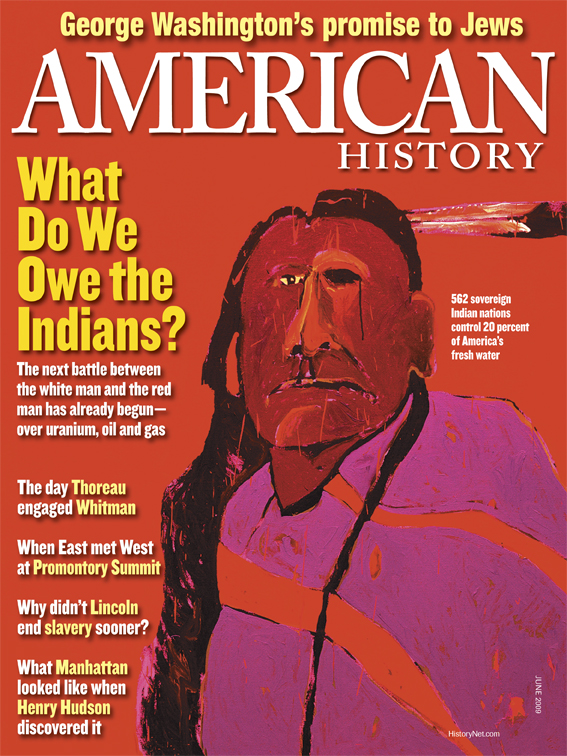
What Do We Owe the Indians?

by Paul VanDevelder  (American History Magazine)


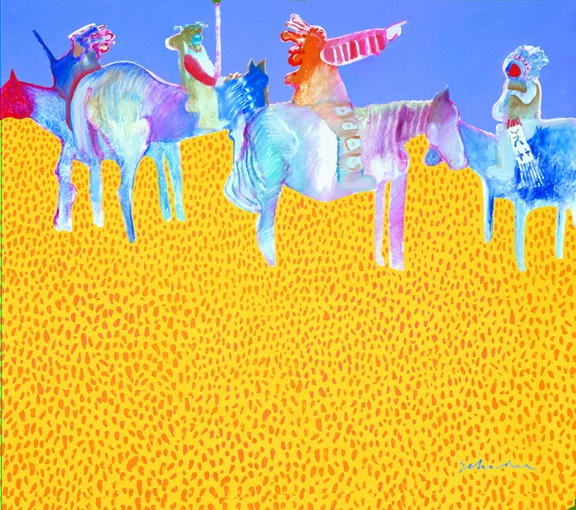
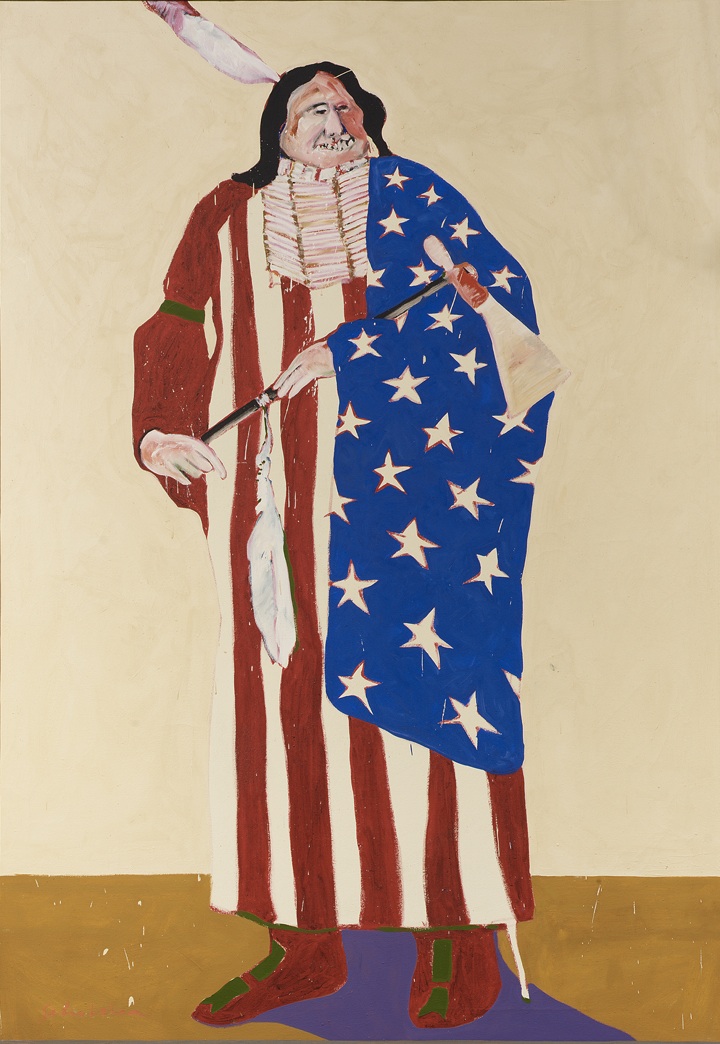
Images accompanying this article are from the Smithsonian’s National Museum of the American Indian exhibition, “Fritz Scholder: Indian/Not Indian,” which is on display in Washington, D.C., through August 16 (www.americanindian.si.edu). All Images copyright Estate of Fritz Scholder.

The Yellowtail ranch, tucked into a narrow valley of soft-rock geology that separates the Big Horn Mountains from the surrounding plains on the southern border of Montana, is not the easiest place to find. Hang a right at Wyola, population 100, the home of the “Mighty Few” as Wyolians are known to their fellow Crow Indians, and head straight for the mountains. This is the rolling rangeland where Montana got its famous moniker, Big Sky Country. Eventually a red sandstone road will take you to a small log cabin on Lodge Grass Creek, 26 miles from the nearest telephone.

The Crow Indian Nation once stretched for hundreds of miles across this high plains grassland without a single road, fencepost or strand of barbed wire to mar the view. Then, in 1887, the federal government cast aside its treaty obligations to the Crow and other tribes and opened up their homelands to white settlers. Cattle soon replaced buffalo, and a hundred years later, about the same time the economics of the cattle industry began circling the drain, geologists discovered that the Big Horn Mountains are floating on a huge lake of crude oil. It wasn’t long before guys in blue suits and shiny black cars were cruising the back roads of Crow country and gobbling up land and mineral rights for pennies on the dollar. By hook and crook, the Yellowtails managed to keep their 7,000-acre chunk of that petrochemical dream puzzle. “We just barely hung on to this ranch in the ’80s,” says Bill Yellowtail, who, in addition to being a cattleman, has been a state legislator, a college professor, a fishing guide and a regional administrator for the Environ�mental Protection Agency. “It was dumb luck, I guess. And stubbornness.”

At 6 feet 2 inches tall and 250 pounds, Yellowtail is a prepossessing figure, and no matter where his life mission takes him, his spirit will always inhabit this place. When his eyes take in the 360-degree view of soaring rock and jack-pine forest and endless blue sky, he sees a wintering valley of 10,000 bones that has been home to his clan for nearly a millenium. And because his inner senses were shaped by this land, by this scale of things, his vision of the future is a big picture. “The battle of the 21st century will be to save this planet,” he says, “and there’s no doubt in my mind that the battle will be fought by native people. For us it is a spiritual duty,” says Yellowtail, sweeping his hand across the thunderous silence of the surrounding plains from the top of a sandstone bluff, “and this is where we will meet.”

What Yellowtail describes with the sweep of his hand is not so much a physical place as a metaphorical landscape where epic legal battles over the allocation and distribution of rapidly diminishing natural resources are destined to be fought. Tacitly, those looming battles echo a question that Americans have finessed, deflected or avoided answering ever since the colonial era: What do we owe the Indian? Long before the United States became an independent nation, European monarchs recognized the sovereignty of Indian nations. They made nation-to-nation treaties with many of the Eastern tribes, and our Founders, in turn, acknowledged the validity of these compacts in Article VI, Clause 2 of the U.S. Constitution, which describes treaties as “the supreme law of the land.” Once the Constitution was ratified, the new republic joined a pre-existing community of sovereign nations that already existed within its borders. Today, the United States recognizes 562 sovereign Indian nations, and much of what we owe them is written in the fine print of 371 treaties.

In 2009, Indians comprise about 1 percent of the population, and irony of ironies, the outback real estate they were forced to accept as their new homelands in the 19th century holds 40 percent of the nation’s coal reserves. And that’s just for openers. At a time when the nation’s industrial machinery and extractive industries are running out of critical mineral resources, Indian lands hold 65 percent of the nation’s uranium, untold ounces of gold, silver, cadmium, platinum and manganese, and billions of board feet of virgin timber. In the ground beneath that timber are billions of cubic feet of natural gas, millions of barrels of oil and a treasure chest of copper and zinc. Perhaps even more critically, Indian lands contain 20 percent of the nation’s fresh water.

Tribal councils are well aware of the treasures in the ground beneath their boots and are determined to protect them. Fifteen hundred miles southwest of Yellowtail Ranch, Fort Mojave tribe lawyers thwarted a government nuclear waste facility in Ward Valley, Calif. Eight hundred miles east of Ward Valley, Isleta Pueblo attorneys recently won a U.S. Supreme Court contest that forced the city of Albuquerque to spend $400 million to clean up the Rio Grande River. Northwest tribes won the right to half of the commercial salmon catch in their ancestral waterways, including the Columbia and Snake rivers. And, after a 20-year-long legal battle, the Potawatomi and Chippewa tribes of Wisconsin prevented the Exxon Corporation from opening a copper mine at Crandon Lake, a battle Indian lawyers won by enforcing Indian water rights and invoking provisions in the Environmental Protection Agency’s Clean Air Act.

The Indian Wars of the 19th century were largely fought over land because the federal government refused to uphold its various treaty obligations. The spoils in the 21st-century battles will be natural resources, and underlying those battles will be the familiar thorn of sovereignty. “Back in the old days,” says Tom Goldtooth, the national director for the Indigenous Environmental Network, “we used bows and arrows to protect our rights and our resources. That didn’t work out so well. Today we use science and the law. They work much better.”

None of our laws are more deeply anchored to our national origin than those that bind the fate of the Indian nations to the fate of the republic. And none of our Founding Fathers viewed the nation’s debt to the Indians with greater clarity than George Washing�ton. “Indians being the prior occupants [of the continent] possess the right to the Soil,” he told Congress soon after he was elected president. “To dispossess them…would be a gross violation of the fundamental Laws of Nature and of that distributive Justice which is the glory of the nation.” In Washington’s opinion, the young war-depleted nation was in no condition to provoke wars with the Indians. Furthermore, he warned Congress that no harm could be done to Indian treaties without undermining the American house of democracy.

The country had no sooner pushed west over the Allegheny Mountains than problems began to emerge with the Constitution itself. The simple model of federalism envisioned by the Founders was proving unequal to the task of managing westward migration. Nothing in the Constitution explained how the new federal government and the states were going to share power with the hundreds of sovereign Indian nations within the republic’s borders. The Constitution’s commerce clause was designed to neutralize the jealousy of states by giving the federal government exclusive legal authority over treaties and commerce with the tribes, but when Georgia thumbed its nose at Cherokee sovereignty in 1802 by demanding that the entire nation be removed from its territory, the invisible fault line in federalism suddenly opened into a chasm.

The Indians found themselves entangled in a fierce jurisdictional battle that they had no part in starting. It was not their fight, but when the smoke and dust finally settled four decades later, the resolution would be paid for in Indian blood. Georgia’s scheme was to bring the issue of states’ rights to a national crisis point, and it worked. Bewailing the arrogance of “southern tyrants,” President John Quincy Adams declared that Georgia’s defiance of federal law had put “the Union in the most imminent danger of dissolution….The ship is about to founder.” Short of declaring war against Georgia and its sympathetic neighbors, the nation finally turned in desperation to the Supreme Court.

When the concept of Indian sovereignty was put to the test, Chief Justice John Marshall offered up a series of judgments that infuriated Southern states’ rights advocates, including his cousin and bitter rival Thomas Jefferson. In three landmark decisions, known as the Marshall Trilogy issued between 1823 and 1832, the court laid the groundwork for all subsequent federal Indian law. In Johnson v. McIntosh, Marshall affirmed that under the Constitution, Indian tribes are “domestically dependent nations” entitled to all the privileges of sovereignty with the exception of making treaties with foreign governments. He explained in Cherokee Nation v. Georgia and Worcester v. Georgia that the federal government and the Indian nations are inextricably bound together as trustee to obligee, a concept now referred to as the federal trust doctrine. He also ruled that treaties are a granting of rights from the Indians to the federal government, not the other way around, and all rights not granted by the Indians are presumed to be reserved by the Indians. This came to be known as the reserved rights doctrine.

The federal trust doctrine and the reserved rights doctrine placed the government and the tribes in a legally binding partnership, leaving Congress and the courts with a practical problem—guaranteeing tribes that American society would expand across the continent in an orderly and lawful fashion. Inevitably, as disorderly and unlawful expansion became the norm—by common citizens, presidents, state legislators, governors and lawmakers alike—the conflict of interest embedded in federalism gradually eclipsed the rights of the tribes.
For their part, President Andrew Jackson and the state of Georgia scoffed at Marshall’s rulings and accelerated their plans to remove all Indians residing in the Southeast to Oklahoma Territory. Thousands of Cherokee, Choctaw, Creek and Chickasaw Indians died in forced marches from their homelands. Eyewitness reports from the “trail of tears” were so horrific that Congress called for an investigation. The inquiry—conducted by Ethan Allen Hitchcock, the grandson of his revolutionary era namesake—revealed a “cold-blooded, cynical disregard for human suffering and the destruction of human life.” Hitchcock’s final report, along with supporting evidence, was filed with President John Tyler’s secretary of war, John C. Spencer. When Congress demanded a copy, Spencer replied with a curt refusal: “The House should not have the report without my heart’s blood.” No trace of Hitchcock’s final report has ever been found.

By 1840 America’s first Indian “removal era” was completed, and within a decade a second removal era would begin. Massive land grabs in the West commenced when Congress passed the Kansas-Nebraska Act of 1854, opening treaty-protected Indian lands to white settlement. While the act is most often remembered as a failed attempt to ease rapidly growing tensions between the North and South by giving settlers the right to determine whether to allow slavery in the new territories, it also embodied a brazen disregard by Washington lawmakers of their trust obligations to Western tribes.

Three decades later, the federal government ignored its trust obligations yet again when the 1887 Dawes Act gave the president the authority to partition tribal lands into allotments for individual Indian families. “Surplus” Indian land was opened up to settlement by white homesteaders, and soon 100 million acres of land once protected by treaties had been wrested from Indian control. Euphemistically known as the Allotments Era, this period lasted until 1934, when Franklin Delano Roosevelt and Congress finally put an end to the land grabs. Meanwhile, federal courts began relying on Marshall’s century-old legal precedents in a series of controversial decisions that forcefully reminded Washington lawmakers of their binding obligations to the tribes. The decisions also prompted jealous state governments to resume their adversarial relationship with tribes, and to treat the tribes’ partner, the federal government, as a heavy-handed interloper.

Although many Allotment Era executive orders were eventually ruled illegal by federal courts, the genie was out of the bottle. There was no way to return the land that had been taken to its rightful owners, and besides, the powerless remnants of once great Indian tribes were lucky to survive from one year to the next. Ironically, the turning point for Indians came decades later, courtesy of Richard Nixon.

On July 8, 1970, in the first major speech ever delivered by an American president on behalf of the American Indian, Nixon told Congress that federal Indian policy was a black mark on the nation’s character. “The American Indians have been oppressed and brutalized, deprived of their ancestral lands, and denied the opportunity to control their own destiny.” Through it all, said Nixon, who credited his high school football coach, a Cherokee, with teaching him lessons on the gridiron that gave him the fortitude to be president, “the story of the Indian is a record of endurance and survival, of adaptation and creativity in the face of overwhelming obstacles.”

In Nixon’s view, the paternalism of the federal government had turned into an “evil” that held the Indian down for 150 years. Henceforth, he said, federal Indian policy should “operate on the premise that Indian tribes are permanent, sovereign governmental institutions in this society.” With the assistance of Sen. James Abourezk of South Dakota, Nixon’s staff set about writing the American Indian Self-Determination and Educa�tion Assistance Act, which gave tribes more direct control over federal programs that affected their members. By the time Congress got around to passing the law, in 1975, Nixon had left the White House in disgrace. But for the 1.5 million native citizens of the United States, the Nixon presidency was a great success that heralded an end to their “century-of-long-time-sleeping.”

Word of Nixon’s initiatives rumbled like summer thunder through the canyon lands and valleys of Indian Country. While the American Indian Movement grabbed national attention by staging a violent siege of the town of Wounded Knee, S.D., in 1973, thousands of young Indian men and women began attending colleges and universities for the first time. According to Carnegie Foundation records, in November 1968 fewer than 500 Indian students were enrolled in schools of higher education. Ten years later, that number had jumped tenfold.

Among the first to benefit from Nixon-era policies was a generation of determined young Indians with names like Bill Yellowtail, Tom Goldtooth and Raymond Cross. “For the first time in living history, Indian tribes began developing legal personalities,” says Cross, a Yale-educated Mandan attorney and law school professor who has made two successful trips to the U.S. Supreme Court to argue the merits of Indian sovereignty. “They realized that federal Indian policies had been a disaster for well over a hundred years. The time had come to change all that.”

As various tribes slowly developed their political power, young college educated Indians came to view efforts to wrest away their natural resources as extensions of 19th-century assaults on sovereignty and treaty rights. Mineral corporations, federal agencies and state governments—emboldened by 160 years of neglect of the government’s trust responsibilities—were accustomed to having their way with Indian Country.

In places like Lodge Grass, Shiprock and Mandaree, long-term neglect of treaty rights had translated into widespread poverty and a 70 percent unemployment rate. In New Town, Yankton and Second Mesa, that neglect meant a proliferation of kidney dialysis clinics and infant mortality rates that would be scandalous in Ghana. In Crow Agency, Lame Deer and Gallup, neglect looked like a whirlpool of dependency on booze and methamphetamines that spat Indian youth out into a night so dark that wet brain, self-inflicted gunshot wounds, cirrhotic livers and the all too familiar jalopy crashes, marked by a blizzard of little white crosses on wind-scoured reservation byways, read like a cure for living. Indians, no less than their counterparts in white society, found themselves prisoners of the pictures in their own heads.
Two hundred and thirty-one years after the new United States signed its first treaty with the Delaware Indians, there is too much money on the table, and too many resources in the ground, for either the Indians or the industrialized world to walk away from Indian Country without a fight. There may be occasional celebrations of mutual understanding and reconciliation, but no one is fooling anybody. The contest of wills will be just as fierce as it was in the Alleghenies in the 1790s, in Georgia in the 1820s, and on the Great Plains in the 1850s. “From the beginning, the Europeans’ Man versus Nature argument was a contrived dichotomy,” says Cross. “The minute you tame nature, you’ve destroyed the garden you idealized. The question that confronts the dominant society today is ‘Now what?’ After you destroy Eden, where do you go from here?”

Meanwhile, on a late Sunday evening inside a cabin on Lodge Grass Creek at Yellowtail Ranch, the weighty matters of the world are at bay. Friends and family have gathered around a half moon table in the kitchen for an evening of community fellowship. No radio. No cell phones. Wide-eyed children lie curled like punctuation marks under star quilts in the living room, listening to grown-ups absorbing each other’s lives. Mostly, the grown-ups dream out loud over cherry pie and home�made strawberry ice cream. Gallons of coffee flow from a blue speckled pot on the stove. At peak moments all seven voices soar and collide in clouds of laughter.

Outside, the Milky Way glows overhead as brightly as a Christmas ribbon. The surrounding countryside is held by a silence so pure, so absolute, that individual stars seem to sizzle. Laughter, happy voices and a shriek of disbelief drift into the night where far overhead a jet’s turbines pull at the primordial silence with a whisper. From 35,000 feet in the night sky, soaring toward tomorrow near the speed of sound, a transcontinental traveler glances out his window and sees a single light burning in an ocean of darkness. He wonders: Who lives down there? Who are those people? What are their lives like?

Far below, that light marks the spot where the Indians’ future meets the Indians’ past, where the enduring ethics of self-sufficiency and interdependence, cooperation and decency, community and spirit are held in trust for unborn generations of Crow and Comanche, Pueblo and Cheyenne, Hidatsa and Cherokee—where people who know who they are gather around half moon kitchen tables to make laughter and share grief. Still there after the storms.

Click to subscribe to American History magazine.
Paul VanDevelder is a writer and documentary filmmaker based in Oregon. His book Coyote Warrior: One Man, Three Tribes, and the Trial That Forged a Nation was nominated for both the Pulitzer Prize and the National Book Award in 2004. His latest book is Savages and Scoundrels: The Untold Story of America’s Road to Empire Through Indian Territory.


THE DESTRUCTION OF BUDDHISM

Howdy-- 
 
I had gotten pretty immune to the never ending stream of "patriotic" billboards and posters along Galle Road, Sri Lanka 's Main Street .  Soldiers in jungle gear, faces smeared with war paint, huge assault guns held in ready position, with lots and lots of bullets draped on them – the jewelry of death.


Because I turn off the propaganda of war (in whatever country I'm in), I almost missed this poster: a little larger than usual, and with more implements of violence (jet fighters, helicopters...).  But, the thing that got my attention was its position: right in front of a huge statue of the Buddha.


My first reaction was: "I didn't see that."  Maybe my mind conjoined two very separate images -- after all, most of Galle Road is a blur to me, after traveling this main traffic artery for over a dozen years.


A few days later, I drove back by.  This time, I asked my driver to stop.  And I took some photos.  And a movie clip, in case someone accuses me of Photoshopping (a verb, akin to plagiarizing).


The war poster caption reads:
"Now we have a country for ourselves,
There is now a tomorrow for you, son."
"We salute you!"


I am not a Buddhist scholar.  I haven't formally studied the religion. But, from the little that I know, I believe the Buddha would unequivocally condemn the violence being done in his name in Sri Lanka .  If that statue could move, it would get up and tear down the poster that glorifies and revels in violence.  If that statue could cry, it would.


All around the world, I see people all too willing to hijack and subvert their most precious spiritual beliefs, to satisfy their lust for blood and their lust for power.


This isn't about a minor deviation from a minor aspect of a hard to understand religious dogma.  It is a major violation of one of the core tenets of one of the world's most important faiths.


But that’s not the bad part: what turns my stomach is the near-silence met by this travesty.


The Life Of Buddhism

For most of us in the world, when we think about the term “Buddhism” we picture the smiling face of the Dalai Lama.  Indeed, for many of us, his stance of nonviolence in the face of Chinese aggression is the epitome of what Buddhism looks like, as practiced.  The Chinese aggression made the Dalai Lama a world-class figure, and Tibetan Buddhism known throughout the world.


The Dalai Lama:

The Face of Buddhist Practice


The Dalai Lama ACTS like being “Buddhist” is more important than being “Tibetan”.   


The Death of Buddhism

When I ask you to think about the term “Buddhism” you probably DON’T think about Sri Lankan Buddhism. 


Recently, I was in the Midwest, doing a presentation on Sri Lanka before an audience of a few dozen people.  To exemplify the Sri Lanka military, I downloaded a few photos of the proud Sri Lankan soldiers in their snappy uniforms, marching.  One woman raised her hand and asked, “I thought Sri Lanka was a Buddhist country.  Where are the Buddhists?” 


To answer, I blew up the picture of the Sri Lanka soldiers, focusing on the hand of the soldier in the foreground.  Around his wrist was a telltale white band.  I told her, “These soldiers ARE the Buddhists.  This band is the cord each one of them received when he went to the Buddhist temple to get the blessings from the monks, before marching off to kill human beings.”


The Seal of Approval


The woman burst into tears.  “I thought Buddhism was DIFFERENT!” she said between her tears.  “I thought Buddhists actually PRACTICED what they talked about!”


A rude awakening. 


Just like Christianity, Islam and everything else, Buddhists are just as likely to fall prey to powerful men who want to re-write the rules to suit their own agenda.  Because the Buddha’s message: “Do no harm to any sentient being” is so clear, it makes the re-write so ludicrous and the attempts at manipulation so blatant and repellent.


But, if the re-write of “DO NO HARM” into “KILL OUR ENEMIES” is so obviously WRONG, what causes millions of otherwise sane and devout Sinhalese to buy into this, to revel in war and violence? More importantly, what causes them to go along with this attempt to conflate their ethnic identity with the OPPOSITE of their religion?


The Burning Buddha

One of the most durable terror symbols in the modern world is the “Burning Cross” of America ’s Ku Klux Klan.  In their heyday, the symbol of the Burning Cross struck fear among millions of America ’s black citizens.  It stood for the widespread practice of lynching, torture and intimidation -- violence done openly and with impunity.  Terrorism, pure and simple.  Terrorism in the name of Jesus.


The KKK: America ’s Home Grown Terrorists


In the light of this cultural terrorism, it’s hard to remember that the Cross represents the doctrine of Jesus, a doctrine of love, nonviolence, inclusivity, and acceptance.  Jesus said that there were only two laws: (1) Obey God, and (2) Love your neighbor as yourself.  (He actually went further and declared that we should LOVE OUR ENEMIES.  I think Jesus and the Buddha would have really gotten along well with each other!)


Into this philosophy of love, nonviolence and inclusivity, the KKK added a superseding Commandment: “Hate and kill those who look, act or think DIFFERENT from you.”  In the doctrine of Jesus (as re-written by the KKK), white skin was more important than any other consideration, including ANYTHING Jesus said to the contrary. 


Fast forward 100 years. Take this doctrine of cultural arrogance to a different continent and a different culture.  Have it based not on the color of skin (everybody in Sri Lanka is some shade of brown) but on language and cultural behaviors. 


The Recipe for Cultural Arrogance:

1.  Start with an unhealthy inferiority complex.  (In the case of BOTH Sinhalese and Tamils in Sri Lanka , I believe the inferiority comes from centuries of colonization.) ANYTIME you see a resort to violence (a man punching his wife, or one country punching another), inferiority lies somewhere in the mix.


2.  Add anger and a misplaced need for revenge (or, the need to “prove” oneself).


3.  Place your CULTURE above your RELIGION.  (Better still: confuse and conflate the two.) 


4.  If available: add a legitimate goal.  The desire to live free from terrorism and the threat of violence is a legitimate goal.  BUT, this goal can be attained NONVIOLENTLY.  Indeed, it is the ONLY way it can be attained.  Don’t believe me?  Ask the Buddha.


Cultural arrogance lies at the intersection of bad nationalism and bad religion.


Bad Nationalism

Now, nationalism or ethnic identity is not by itself a bad thing.  I am very proud of my culture and my history and heritage as an African-American.  And, I know many other Americans are proud of their ethnicities also. But, the key point is this: I don’t need to put anyone else down in order for me to feel good about myself. The need to be “better-than” another person (on the grounds of culture, religion, gender or anything else) is the hallmark of a serious INFERIORITY COMPLEX.  Secure people are not arrogant.  Arrogant people are not secure.


The mixture of a feeling of inadequacy, coupled with the external need to be “better-than” some other group, is the recipe for what I call “bad nationalism”.  By “bad nationalism”, I mean a “national” identity that hyper-inflates the stature of one group within a nation, at the expense of all others. 


Remember: the people that Adolph Hitler and his Nazis put into concentration camps and exterminated – the blacks, the Jews, the Gypsies, the homosexuals – were ALL GERMAN CITIZENS.  Under the Fascists, true “nationalism” – the German nation – was not important.  A false notion of “racial purity” – the Aryan ideal – took its place.  Bad nationalism.


The Sri Lanka “nation” consists of THREE major ethnic groups, not ONE (Sinhalese, Tamil and Muslim).  The Sri Lanka “nation” consists of FOUR major religions, not ONE (Buddhist, Hindu, Muslim and Christian).  The Sri Lanka “nation” speaks THREE languages, not ONE (Sinhala, Tamil and English). 


As any American can tell you, practicing inclusivity and political and cultural pluralism is not easy.  In our relatively short history, America has gotten it wrong more often than right. But, since the Sixties, we have been firmly committed to the path of inclusivity.  And our entire country has benefited from our adherence to the goal of “E Pluribus Unum” (“Out of Many, One.”) Even those who fight against the concept of inclusivity are its beneficiaries. 


Forging one nation in Sri Lanka will be messy.  It always is.  It will involve compromise and sacrifice.  No one will get everything that they want.  But, in the end, all Sri Lankans will be better for it.  And Buddhism will thrive on the island, without the need for protectionist laws against religious conversion.


Bad Religion

Religion can be a beautiful thing.  I have had the privilege and the honor to participate in spiritual ceremonies from virtually every major wisdom tradition on Earth – from Eastern Orthodox Christian ceremonies in the far North to Maori ceremonies in the far South. And everything in between – including Buddhist, Hindu and Muslim ceremonies in Sri Lanka . 


The thing that makes a religion beautiful, the thing that creates MEANING within the religion, is that the ceremonies each REPRESENT something. The actions and rituals represent something in this world and also represent something in the Transcendent realm.  The wisdom teachers (of all faiths) left us a set of moral principles to guide our lives and our societies.


However: when you take the meaning out of the religion, when you scrub away the moral principles, then you are left with a handful of rituals that have no MEANING attached to them.  This is what I call “bad religion”.  Bad religion is full of rituals but devoid of meaning.  It’s like a hungry man sitting down to a dinner of plastic food.  He can put it in his mouth, chew and swallow, but he’s still empty.  Your Spirit cannot be fed by a religion that is almost exactly OPPOSITE to the principles taught by the Buddha.


The philosophy of the Buddha has been feeding the world for over 2,500 years.  The culturally arrogant “anti-Buddha” philosophy has been spiritually starving Sri Lanka for awhile – long enough for Sri Lanka to have one of the world’s highest suicide rates AND one of the world’s highest alcoholism rates.  This is what happens from spiritual stomachs full of plastic.


Those with the guns, planes, cluster bombs and “patriotic” billboards say that they act to “preserve Buddhism”.  (This argument has the same reasoning – and the same lack of morality – as the Christian “just war” doctrine.)  What those gripped by cultural arrogance and the blood-lust cannot understand is this:NOTHING CAN DESTROY BUDDHISM, EXCEPT THOSE WHO BELIEVE IT CAN BE PRESERVED BY VIOLATING ITS PRINCIPLES.


The Way of the Buddha is the way of loving-kindness, compassion and nonviolence.  In its essence, it is the exact opposite of what the current Sri Lankan government is practicing in the Vanni right now.  You can either be a peace-loving Buddhist, or you can be a war-loving chauvinist, BUT YOU CAN’T BE BOTH.


Or, maybe you can.  Maybe, in this crazy, upside-down world, the Buddha of the 21st Century condones, supports and blesses the guys with the biggest guns, the guys who wage the best battles.  Instead of sitting in meditation, maybe this new Buddha will be seen carrying an assault rifle – and a bottle of Arrack (why not? If you violate one principle, why not violate them all?)


There Is Hope

The “good Sinhalese” are out there.  The people who are offended by the war posters are in hiding on the island. While writing this article, I received an email from a Sinhalese friend.     


I am happy you are away from this blood bath and craziness. Most of us are trapped in this hell. I feel shame to be a so called Sinhalese and live in this world.  But, a little bit of remaining Faith and Hope helps me to bear this heavy burden of shame.


Even in the midst of this insanity, I still have hope.  This is not just a stubborn refusal to face facts. This is my way of looking at facts through a long lens.  The one thing that the past 100 years of organized evil has taught us is this – BLOOD-LUST ONLY WORKS IN THE SHORT TERM.  People eventually come to their senses.  In my country, it took us 8 years to wake up from our most recent trance, to retrieve our democracy and our Spirit from the hands of those who wanted to rule the world and were willing to trample underfoot both our Constitution and the lessons of Jesus to achieve their goal. It took about that long for the “good Germans” to realize the horrors that the Nazi government was perpetuating in their name. 


Right now, it is very dangerous for people in Sri Lanka to stand up and speak out.  The blood-lust is high.  The war drums beat.  Political disappearances are at an all-time high.  In Sri Lanka , dissent is dangerous.


But, people will eventually wake up.  Even as the statues of the Buddha are desecrated with the images of war, it is important for us to remember that a statue is a statue… the place the true Buddha resides is in our hearts.  And that’s the place we need to keep clean and clear, as we wait for the blood-lust to spend itself.

May all beings be well.

May all beings be secure.

May all beings be happy.


Peace,


Sharif Abdullah